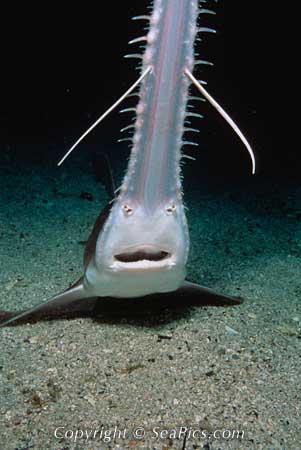
You may not be able to use this saw while woodworking, but if you were to try and catch a fish, it works really well, especially in the hands, I mean snout, of the sawshark. These interesting looking sharks have a long and flat saw-like rostrums studded with 23 teeth. These teeth become miniature spears when they whip their heads side to side will slash prey nearby. Using barbels and electro-receptors on the underside of the rostrum the sawshark can detect prey underneath the sand and then use their saw to uncover them and strike. Once their prey has been disabled they can then ingest the prey in their small mouths.

Sawsharks normally grow to lengths of 3 feet long. There are 9 species of saw shark, the Sixgill Sawshark which has 6 gills, the Longnose Sawshark, Bahamas Sawshark, Eastern Sawshark, the Tropical Sawshark, Philippines Sawshark, the Japanese Sawshark, Shortnose Sawshark, and the Dwarf Sawshark. The general color of all sawsharks are grey on top and white on the underbelly. Brown stripes run down the length of its body as well.
Usually the sawshark is by-catch of fishermen, and deep-water fisheries. The Bahama sawshark is listed as endangered or threatened by Mexico when it adopted the “National Action Plan for Shark Conservation.” Not just the sawshark is threatened by fishing in the Gulf of Mexico, most shark species migrating are affected by this.
If you would like more information on the conservation of all sharks affected by this, you can click here.

 Discover the (Animal) Kingdom