All legends have a grain of truth to them, including the legend of Old Hitler, the largest hammerhead shark. The legend of Old Hitler is known through the Gulf of Mexico, first surfacing in the 1940s and then gaining a large retelling in the mid-1960s. Old Hitler is said to have grown to a length of 25 feet and weighing as much as 2,000 pounds, unbelievable numbers for a great hammerhead!
Old Hitler is said to live in the waters surrounding Tampa, Florida. Tales describe in detail of a swastika-shaped scar on its forehead due to a propeller incident, as well as a fisherman leaving a machete in its dorsal fin when it tried attacking the net being drawn in.
Being reported all across the Gulf of Mexico Old Hitler has yet to be officially found. Who knows, maybe one day someone will find him and document it!
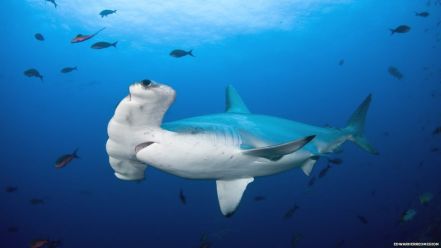
Moving from legends to facts, the great hammerhead shark has to be my favorite species of shark. Not just due to its iconic hammer-shaped head, but its incredible hunting ability due to that. With a field of vision that nearly encompasses 360 degrees combined with the ability to detect prey using the electrical receptors running horizontally down their bodies, they are fearsome apex predators.
Hammerheads feed mainly at the seafloor eating stingray, cephalopods (octopus and squid, crustaceans and even other shark. Great hammerheads have also been reported to pin their favorite prey, the stingray, into the sea floor while devouring their wings. Due to their large size, great hammerheads are not preyed on by other marine life.
The great hammerhead is one of nine different species of hammerhead, including the bonnethead and scalloped hammerheads. The total lifespan of all hammerheads is anywhere from 20 to 30 years, growing anywhere from 13 to 20 feet in length and weighing up to 1,000 pounds.
Most hammerheads are fairly small and are considered harmless to humans. The main hammerhead that is potentially dangerous to humans is the great hammerhead, mainly due to their large size. Few hammerhead attacks have been recorded though.
Like many of their cousins, the hammerhead is fished for their meat, oils, hide, fins and jaws. Due to this, hammerheads are listed as endangered by the IUCN.
To join the conservation efforts of not only the hammerhead, but also the oceans, you can click here.

 Discover the (Animal) Kingdom
GREAT ininformation
LikeLike